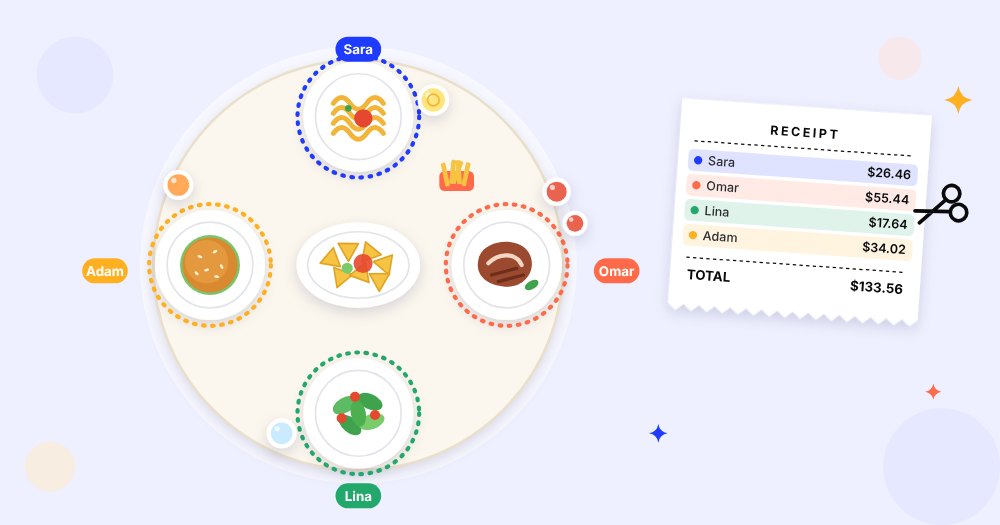
The bill arrives, the table goes quiet, and someone says "let's just split it". Sometimes that's perfectly fair. Sometimes it means the person who had a salad and water pays for someone else's steak and two cocktails.
There's no single right way to split a restaurant bill, but there are three fair ones. This guide shows each method with the same real-world example, so you can see exactly how much each person pays, and when each method makes sense.
The three fair ways to split a bill
- Equal split. Divide the final total by the number of people. Fast and friendly.
- Itemized split. Everyone pays for their own dishes and drinks, plus their part of anything shared, plus their share of tax and tip.
- Hybrid split. Shared items are divided equally, personal items are paid by whoever ordered them. In practice this is how most itemized splits work.

One dinner, three ways to split it
Four friends, Sara, Omar, Lina and Adam, have dinner. Here is what they ordered:
| Person | Ordered | Cost |
|---|---|---|
| Sara | Pasta ($14), lemonade ($4) | $18.00 |
| Omar | Steak ($32), two sodas ($6) | $38.00 |
| Lina | Salad ($11), water | $11.00 |
| Adam | Burger ($16), juice ($5) | $21.00 |
| Shared | Nachos for the table ($12), fries for Omar and Adam ($6) | $18.00 |
| Subtotal | $106.00 | |
The restaurant adds 8% tax ($8.48), and the group leaves an 18% tip on the pre-tax subtotal ($19.08). The bill comes to $133.56.
Method 1: equal split
$133.56 ÷ 4 = $33.39 each. One calculation, done.
But look at Lina. Her own food came to $11, and her part of the nachos is $3. She's paying $33.39 for $14 worth of food. Omar ordered $44 of food (his steak, his sodas and his shares of the nachos and fries) and is also paying $33.39. The equal split quietly moves about $16 from Lina's pocket into Omar's dinner.
Method 2: itemized split (with shared dishes)
First work out each person's food, including their part of what they shared. The nachos were for all four, so that's $3 each. The fries were shared by Omar and Adam, so $3 each for them.
| Person | Own items | Shared | Food total |
|---|---|---|---|
| Sara | $18.00 | $3.00 | $21.00 |
| Omar | $38.00 | $6.00 | $44.00 |
| Lina | $11.00 | $3.00 | $14.00 |
| Adam | $21.00 | $6.00 | $27.00 |
| Total | $106.00 |
Now add tax and tip in proportion. Tax (8%) and tip (18%) together are 26% of the subtotal, so each person pays their food total × 1.26:
| Person | Food | Tax | Tip | Pays |
|---|---|---|---|---|
| Sara | $21.00 | $1.68 | $3.78 | $26.46 |
| Omar | $44.00 | $3.52 | $7.92 | $55.44 |
| Lina | $14.00 | $1.12 | $2.52 | $17.64 |
| Adam | $27.00 | $2.16 | $4.86 | $34.02 |
| Total | $106.00 | $8.48 | $19.08 | $133.56 |
The four amounts add up to exactly $133.56. Lina now pays $17.64 instead of $33.39, and Omar pays for the steak he chose.

Method 3: the hybrid shortcut
If itemizing every drink feels like too much, a common middle ground is: split the shared food equally, and let each person cover their own main and drinks. That's what the "shared" column above does. You get most of the fairness of an itemized split with much less arithmetic.
How to choose the right method
| Situation | Best method |
|---|---|
| Everyone ordered similar food and drinks | Equal split |
| Family-style meal where everything was shared | Equal split |
| One or two people ordered much more (or much less) | Itemized split |
| Some people drank alcohol and others didn't | Itemized, or hybrid with drinks paid separately |
| Shared starters but different mains | Hybrid split |
| Large group, one person paying the restaurant | Itemized, then everyone pays the payer back |
A useful rule of thumb: if the cheapest and most expensive orders are close, the time and goodwill saved by an equal split are worth more than the difference. If one person's order is double another's, itemize. The step-by-step guide to splitting when everyone ordered different food walks through that case in detail.
What about tax and tip?
With an equal split, tax and tip are divided equally too, so there's nothing extra to do. With an itemized split, divide them in proportion to each person's food total, as in the example. That way the person who ordered more pays more tax and tip, which matches how those amounts were calculated in the first place. Service charges, VAT that's already included in menu prices, and the question of tipping on the pre-tax or post-tax amount are covered in how to calculate and split restaurant tax and tips.
Make the shares add up
When you divide by three, six or seven, amounts often don't come out to whole cents. $100 split three ways is $33.333…, and if everyone pays $33.33 the restaurant is a cent short. The fix is simple: round everyone down to the cent, then give the leftover cents to one or two people. One person pays $33.34 and two pay $33.33. Before anyone pays, check that the shares add up to the bill exactly.

Tips for a smooth split
- Agree on the method before ordering if the group is large or budgets differ. It's much easier than negotiating over the receipt.
- Ask the restaurant early if you'd like separate checks. Some places can't split a bill many ways at the end of the night.
- Let one person pay and have everyone pay them back. It's quicker for the restaurant, and the itemized amounts make it easy.
- Keep the receipt until everyone has paid, so anyone can check their share.
Frequently asked questions
Is it rude to ask to pay only for what I ordered?
No. Asking to itemize is reasonable, especially if your order was much smaller than everyone else's. It's easiest to raise before ordering, or to suggest it in a matter-of-fact way when the bill arrives.
Should tip be split equally or by what people ordered?
With an itemized split, divide the tip in proportion to each person's food total. With an equal split, divide it equally along with everything else.
What's the fairest way to split shared dishes?
Divide each shared dish only among the people who actually ate it. If one person had more, for example three of eight slices of pizza, divide it by portion instead of equally.
What if the shares don't add up to the total?
Round each share down to the cent and give the leftover cents to one or two people, so the total is exact. A bill splitter does this automatically.